
During Formation of the heart, two pieces of the wall grow to overlap each other to divide the upper chambers (atria) of the heart into right and left chambers. Before birth, the lower divider acts as a flap or tunnel which allows blood to flow from the right side of the heart to the left side. After birth, right to left blood flow is no longer needed. The two dividers of the right and left atria fuse to form a solid wall (septum). The septum is fused in 90% of people by 18 months of age. However, the dividers which form the septum do not fuse in 10% of people leaving a flap or tunnel which may open and close as right heart pressure changes. This opening (flap or tunnel) is the Patent Formen Ovale or PFO.
In the normal adult heart, the right and left sides are completely separated.
Why PFO cause strokes
Blood from the body enters the right atrium and flows to the lungs.
Filtered blood from the lungs carries oxygen and is pumped to the brain and organs of the body. With a PFO present, blood from the body can bypass the lungs and travel to the left side of the heart. In the normal heart (no PFO), a blood clot from the body would be stopped in the lungs. But if a clot crosses the PFO, it can go to the brain causing a stroke. Where do blood clots come from to cause stroke in patients with a PFO? Blood clots may form in the veins in the legs, break lose, and travel with blood flow to the heart. These clots may pass through the PFO causing a stroke.
Or, blood trapped within the PFO flap or tunnel for a period of time may clot.
When increased pressure in the right heart opens the flap of the PFO, the clot may dislodge and travel to the left side of the heart and then to the brain.

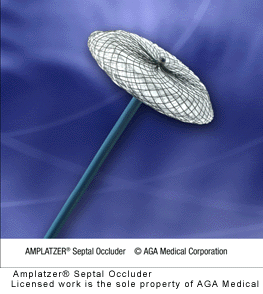
The Amplatzer SO device (I named mine Bob) is approved for septal defect closure. It has been used “off-label” for PFO closure and in a recent survey (TCT 2005), 90% of centers reported use of this device for PFO closure. Use of devices or medications “off-label” is common, legal, and accepted in medical practice. Indeed, in many circumstances “off-label” treatments are mandatory.
The closure device is delivered to the heart through a small catheter or tube. The ICE (echo) catheter is placed in the same vein.

These catheters are introduced into the body through a major vein in the groin. After the procedure, the catheters are removed and sutures are not needed.
TEE (echo) or more commonly Intra-Cardiac Echo (or ICE) and fluoroscopy ( low level xrays) are used to safely and accurately place the devices in the heart. The ICE catheter is placed in the same vein as the device delivery catheter.
The discs or umbrellas on each side of the atrial septum (divider) hold onto the tissue and “pinch” the PFO closed. The SO device “pinches + fills” the septal defect. Device stability and completeness of closure are confirmed by the ICE images immediately during the procedure.

2 comments:
Wow- alot of info!
I am just glad you are okay :)
I'm glad everything went ok! I hope Bob treats you well dear friend!
PS. I am all for a set up. How is this person of which you speak?
Post a Comment